About this translation. This article presents the author's analysis as of October 28, 2026. It preserves that legislative snapshot rather than presenting the proposals or expected dates as an update to current law. Confirm the final decree and applicable rules before acting. The supplied illustrations retain their original Spanish text.
The 2027 tax reform in 60 seconds
The 2027 tax reform described here does not raise Mexico's corporate income-tax rate (ISR, 30%) or general value-added tax rate (IVA, 16%), but would make many businesses pay more tax. It does so by broadening the taxable base: limiting deductions, the use of tax-loss carryforwards and interest deductions.
For business owners, the useful question is not simply whether tax rates have increased. It is how much additional cash will leave the business in 2027 and what can be done before January 1. This article addresses the tax, financial and legal implications, including a potential tax amparo—a constitutional challenge—or an administrative annulment action.
- Who is affected: legal entities, particularly medium-sized and large businesses, leveraged companies, corporate groups and businesses paying for services or royalties abroad.
- What changes: authorized deductions, tax-loss carryforwards, interest deductions, the timing of certain deductions, the CUCA and CUFIN tax accounts, and the corporate-group regime.
- When: the expected start is January 1, 2027, after completion of the legislative process and publication in the Federal Official Gazette (DOF).
- How to respond: plan before the end of 2026 and, where appropriate, assess a constitutional challenge to tax legislation. Filing periods are short and cannot simply be extended.
Where does the reform stand? Legislative status as of October 28, 2026
At the original article's cutoff, both chambers had approved the 2027 Federal Revenue Law (LIF) and Federal Fees Law (LFD) and sent them to the Executive for publication. The amendment to the Income Tax Law (LISR), however, had returned to the Chamber of Deputies because the Senate changed one article.
| Date | Body | Development reported in the original |
|---|---|---|
| October 27, 2026 | Senate plenary | Approves the LIF and LFD without changes. Approves the LISR with an amendment to Article 78-E and returns it to the Chamber of Deputies (Proceso, in Spanish) |
| October 21, 2026 | Senate committees | Approve the three bills without changes (Diario de Yucatán / El Universal, in Spanish) |
| October 13–15, 2026 | Chamber of Deputies plenary | Approves the LFD, LISR and LIF (Deloitte, in Spanish). Committee changes concern foreign payments, maquiladoras and real-estate trusts (Bloomberg Línea, in Spanish) |
| September 8, 2026 | Federal Executive | Submits the 2027 Economic Package: economic policy guidelines, revenue and expenditure proposals, and amendments to the LISR and LFD (Greenberg Traurig, in Spanish) |
What remained outstanding. The Chamber of Deputies had to vote on the part amended by the Senate, under Article 72(E) of the Constitution, followed by publication of the decree in the DOF. The expected effective date was January 1, 2027.
What the Senate changed. It excluded two sectors from the new deduction-control mechanism: the automotive industry operating under a bonded-warehouse authorization for vehicle assembly and manufacturing, and businesses selling, distributing or marketing gasoline and diesel under a valid permit (Proceso, in Spanish).
Each last-minute sectoral exception has legal significance. If a fuel retailer is excluded while a grocery or steel distributor with similar margins remains covered, that distinction may support the tax-equity argument discussed below.
Income-tax changes that would affect businesses
The reform's central feature is a new Chapter X in Title II of the LISR, Articles 78-A through 78-F: a mechanism controlling authorized deductions and tax losses. It applies to legal entities with taxable revenue above MXN 50 million that report a taxable profit. The original reports that the Chamber of Deputies approved the committee opinion without substantial changes to the proposal (TaxToday / Thomson Reuters; Parliamentary Gazette, October 13, 2026, in Spanish).
| Topic | Change described for 2027 | Business implications |
|---|---|---|
| Deduction cap: Article 78-B | If deductions are no more than 96.67% of revenue, only 99% of those deductions are allowed. Above that threshold, deductions are capped at 96.67% of revenue | Creates a minimum taxable profit. The unused balance is inflation-adjusted and may be used over the next 20 fiscal years, again subject to the cap |
| Tax losses: Article 78-C | Losses may offset only 50% of already-adjusted taxable profit | Tax becomes payable despite accumulated losses. The period for using pre-2027 losses extends to 20 fiscal years |
| 2027 provisional payments | The profit coefficient is multiplied by 1.0658 or 2.6162, depending on the previous year's deduction level. Loss offsets are also capped at 50% | Cash flow is affected by the payment due in February, rather than only by the annual return |
| Interest: Article 28(XXXII) | The limit on deductible net interest falls from 30% to 20% of adjusted taxable profit | Increases financing costs, especially for intragroup debt and leveraged acquisitions |
| Foreign payments: Articles 147 and 153, among others | Deductible only in the year the consideration is paid and withholding tax is remitted. Withholding arises on the earliest of enforceability, accrual or payment | Royalties, intercompany services and technical assistance may not be deductible in the year they are booked |
| Advance payments | Service and rental advances are deducted when the service is provided or the relevant use period elapses | Payment alone no longer triggers the deduction |
| CUCA and share tax basis | Capitalized liabilities exclude unpaid accrued interest and VAT. Contributed receivables count only when collected | Affects capital repayments, share sales and restructurings. CUCA is the capital contribution tax account |
| CUFIN | Expenditures failing deduction requirements also reduce the net tax profit account | Reduces dividends distributable without additional corporate income tax |
| Optional corporate-group regime | Repealed from January 1, 2027, with deferred ISR payable under transitional provisions | Groups lose deferral and must reconstruct balances |
| Corporate RESICO | Revenue ceiling rises from MXN 35 million to MXN 50 million; participation becomes optional | A possible alternative to Chapter X for qualifying medium-sized businesses under the Simplified Trust Regime |
| Incentives | Immediate and additional deductions for investment, training and innovation linked to Plan México and development hubs, through 2030 | Investment planning may offset part of the additional cost |
Table sources, in Spanish: EY México, Greenberg Traurig and TaxToday.
Exclusions under Article 78-E. The original identifies coordinated road-transport entities, the primary sector, maquiladoras except for domestic sales, bankrupt companies, insurers, recipients of certain incentives and companies registered with the Federal Taxpayer Registry (RFC) for fewer than five fiscal years. If the Chamber of Deputies accepts the Senate amendment, the exclusions would also cover qualifying automotive bonded-warehouse operations and permitted fuel retailers.
The anti-avoidance rule. The age-based exclusion does not apply where a new company receives assets, customers, brands or contracts from another company with the same shareholders. Nor does it benefit companies arising from mergers or spin-offs carried out from September 8, 2026. A new company cannot automatically obtain a fresh start for these purposes.
Federal Revenue Law, customs and fuels: other business implications
The original describes the approved 2027 Federal Revenue Law as offering a broad tax-regularization opportunity. It reports that the Chamber of Deputies removed the proposed MXN 300 million ceiling and the exclusion of large taxpayers (TaxToday).
| Measure | Rule described | Business implications |
|---|---|---|
| Tax Regularization Program: Twenty-First Transitional Article | Waiver of 100% of penalties, late-payment surcharges and enforcement costs upon payment of inflation-adjusted principal; 90% for formal-compliance penalties. Covers liabilities from 2025 or earlier. Applications by October 31, 2027; payment by December 31, 2027 | May help resolve contingencies before a sale, merger or financing. For final tax debts, the program requires withdrawal of legal challenges. Excludes specified tax offenses, nonexistent transactions and false invoices |
| Surcharges | 1.38% monthly for extensions; 1.42%, 1.63% and 1.97% monthly for installment arrangements | Financing through unpaid tax costs more than 16% annually on a simple-interest basis |
| Repatriation of capital | 7.5% ISR without deductions on lawful funds held abroad as of September 8, 2026, returned before December 31, 2027 and invested in Mexico for at least three years | An option to assess for family treasuries and groups holding cash abroad |
| Initial public offerings | Preferential 10% tax on IPO gains, subject to conditions and limits | May reduce the tax cost of a public-market exit for qualifying family businesses |
| FIBRAS | The 95% minimum distribution rule is adjusted so the deduction cap does not require distributions of cash that is not available | Acknowledges a potential mismatch between taxable profit and cash for Mexican real-estate investment trusts |
| Fuel excise tax: IEPS | Control and payment regime for traders other than producers and importers, from July 1, 2027 | Greater tax oversight of fuel supply chains |
| Zero-rated VAT | Bookstores whose books, newspapers and magazines account for at least 90% of revenue | A targeted sectoral incentive |
The original also reports congressional approval of Customs Law amendments strengthening verification powers and addressing undervaluation (Deloitte, Fiscal Flash 38/2026, in Spanish). For importers and businesses operating under the IMMEX manufacturing and export-services program, the issue would extend to customs valuation as well as ISR.
The FIBRAS rule is particularly relevant to the author's analysis: an adjustment addressing taxable profit without corresponding cash may support a legal argument that the deduction cap can tax an amount that does not reflect actual economic capacity.
Financial impact: the statutory rate stays unchanged, but the effective rate rises
For a business with MXN 200 million in revenue, the mechanism described could increase ISR by between 9% and 66% without changing the 30% statutory rate. The outcome depends on its actual profit margin and accumulated tax losses.
| Scenario | ISR in 2026 | ISR in 2027 | Change | Effective rate on actual profit |
|---|---|---|---|---|
| Wider margin: MXN 180 million in deductions; MXN 20 million actual profit | MXN 6.00 million | MXN 6.54 million | +9% | 32.7% |
| Narrow margin: MXN 196 million in deductions; MXN 4 million actual profit | MXN 1.20 million | MXN 2.00 million | +66% | 50.0% |
| MXN 30 million in prior losses and MXN 180 million in deductions | MXN 0.00 million | MXN 3.27 million | From no tax to tax payable | 16.4% |
Hyperion's illustrative calculations apply the mechanics of Articles 78-B and 78-C described in the proposal and committee opinion. Figures exclude employee profit sharing (PTU), inflation adjustments, incentives and the future effect of unused deduction balances. Displayed amounts are rounded.
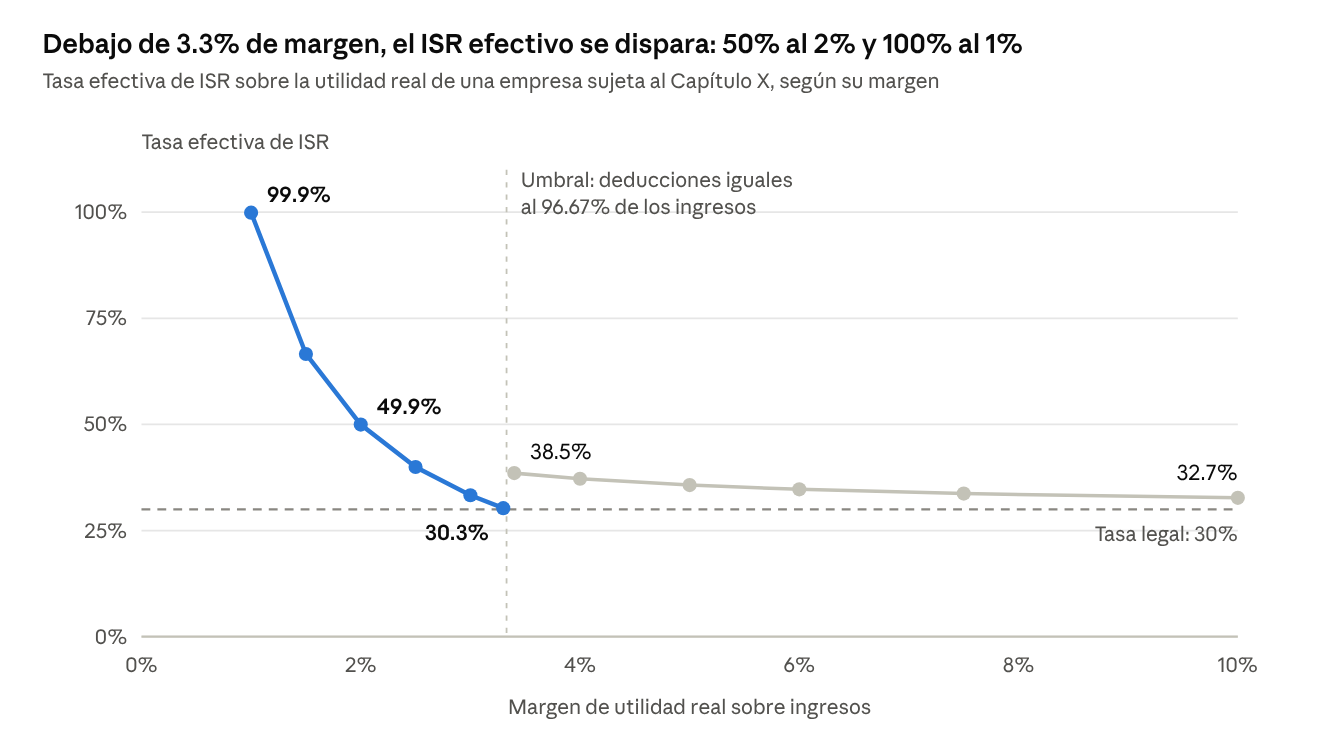
A de facto minimum income tax. Where deductions exceed 96.67% of revenue, the cap produces ISR of approximately 1% of revenue before considering the separate loss-offset rules: 30% of 3.33%. For traders, distributors, construction businesses, transport operators and low-margin service companies, the tax calculation becomes increasingly tied to sales rather than actual profit.
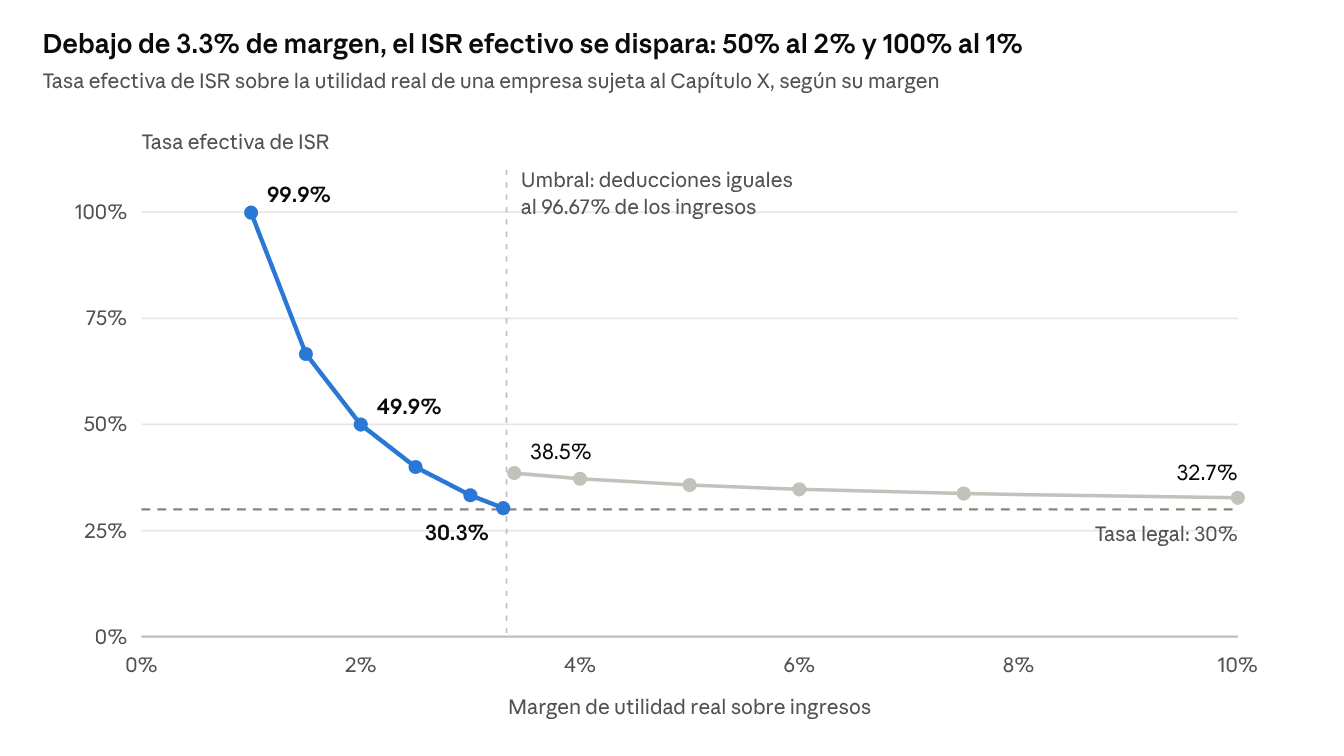
View the full-size chart, with original Spanish labels.
Hyperion calculation using the Article 78-B mechanism and a 30% statutory ISR rate; excludes losses, PTU and incentives.
The jump between a 3.3% and a 3.4% profit margin illustrates the 96.67% threshold: the company with the higher margin faces a higher effective rate, approximately 38.5% versus 30.3%.
The cash impact arrives in February, rather than March 2028. Applying the 2.6162 multiplier to a profit coefficient of 0.0200 produces approximately 0.0523 for provisional payments. Treasury planning must account for the January 2027 tax period and its payment in February.
Debt becomes more expensive, while capital is not a simple alternative. The 20% interest limit increases financing costs for businesses exceeding the MXN 20 million interest threshold under Article 28(XXXII). The CUCA changes also make capitalizing liabilities less attractive. Both sides affect capital-structure decisions.
Tax losses lose present value. A 50% annual utilization cap delays recovery of deferred tax assets. That can affect valuations, business-sale prices and recoverability assessments in financial statements.
Prices may absorb part of the impact. In low-margin sectors, additional ISR acts like a variable cost and may prompt renegotiation of supply contracts in 2027.
Business expenses: deductible does not always mean an immediate tax saving
Under the mechanism analyzed, a business expense could be strictly necessary, properly invoiced and paid without reducing ISR in the same year. Once deductions exceed 96.67% of revenue, each additional deductible peso enters a balance carried forward for up to 20 years, with no immediate tax saving.
| Expense or item | Change described for 2027 | Review before December 31, 2026 |
|---|---|---|
| General operating expenses | Under the 99% rule, each deductible peso saves 29.7 centavos rather than 30. Above the cap, the current-year saving is zero | Identify expenses that can lawfully accrue and be paid in 2026 |
| Foreign royalties, intercompany services and technical assistance | Deduction in the year payment is made and withholding tax is remitted | Pay and withhold on accrued items before year-end where appropriate; review contractual due dates |
| Rent and service advances | Deducted as services are provided or the use period elapses | Review multiyear prepayment contracts |
| Interest | Limit of 20% of adjusted taxable profit | Review debt structure, intragroup rates and banking covenants |
| Expenses failing tax requirements | Also reduce CUFIN | Review invoices and supporting evidence before declaring dividends |
| Fixed-asset investment and training | Immediate and additional deduction incentives linked to Plan México and development hubs, through 2030 | Assess eligibility and document qualifying investment from the outset |
Evidence that transactions actually occurred matters more than ever. The explanatory memorandum links the deduction mechanism to combating businesses issuing invoices for nonexistent transactions. The author anticipates audits focused on deductions, using Article 69-B of the Federal Tax Code (CFF) and the Article 5-A business-purpose rule. Each deduction should have a contract, evidence of performance or delivery, and proof of payment.
PTU is separate. According to the EY México analysis cited in the original, in Spanish, Chapter X operates for ISR purposes; the new cap does not inflate the employee profit-sharing base.
Corporate and contractual implications
The reform calls for reviewing contracts, corporate records and structures as well as tax returns. Discovering the consequences late—in an audit, a sale or litigation—can be more costly than addressing the additional tax in advance.
- Commercial and supply contracts. Long-term agreements with fixed margins need appropriate tax-law change or price-review provisions. Otherwise, the supplier may absorb the cap's entire cost.
- Intercompany and cross-border contracts. Enforceability and payment dates affect deduction and withholding timing. Poor drafting can postpone a royalty deduction while triggering withholding earlier.
- Financing. Additional ISR may cause breaches of covenants based on after-tax profit or free cash flow. Review and, where necessary, renegotiate before a breach occurs.
- Corporate governance. Capital contributions need payment and documentary support for CUCA purposes. Dividend policies require recalculation using CUFIN. Board records should document the adopted tax strategy.
- Mergers, spin-offs and acquisitions. The economic-continuity rule and September 8, 2026 cutoff make reorganizations without a business purpose risky. Lower tax-loss values affect transaction pricing, tax representations and indemnities.
- Corporate groups. Exit from the optional regime requires reconstructing balances and scheduling deferred ISR payments under transitional provisions.
- Tax and corporate criminal compliance. Deductions involving invoices for fictitious transactions can lead to tax offenses and, in specified cases, criminal liability for the legal entity. Effective controls help manage that exposure.
- Choice of tax regime. Under the described changes, legal entities with revenue up to MXN 50 million could elect RESICO. The decision requires financial modeling and a review of ownership requirements through the appropriate corporate decision-making process.
Amparo or administrative annulment: which legal remedy applies?
The two procedures address different issues. An amparo against tax legislation can challenge the constitutionality of the deduction and loss limits. An administrative annulment action before the Federal Court of Administrative Justice (TFJA) addresses specific decisions by the Tax Administration Service (SAT) and administrative rules that exceed the statute. Constitutional arguments may also arise in a direct amparo following a TFJA judgment.
| Remedy | Challenged measure | Filing period discussed | Potential purpose |
|---|---|---|---|
| Indirect amparo against a self-applying provision | LISR provisions imposing obligations immediately upon taking effect, potentially including provisional-payment adjustments | 30 working days from entry into force, under Articles 17(I) and 18 of the Amparo Law. For an effective date of January 1, 2027, the original estimates a deadline around mid-February; the exact calendar must be calculated | Obtain relief from application of the mechanism to the claimant and seek recovery of excess payments |
| Amparo against the first act of application | The first provisional payment or return applying the provision, or a SAT act | 15 working days under Article 17 of the Amparo Law, subject to the applicable triggering event | Assess relief where no challenge was filed upon entry into force |
| Administrative annulment before the TFJA | Tax assessments, disallowed deductions, refund refusals, and general rules challenged with their first application | 30 working days from the applicable notification trigger under Article 13 of the Federal Administrative Litigation Procedure Law | Address calculation errors, proof of transactions, interpretation of transitional rules and administrative rules exceeding the statute |
| Direct amparo against the TFJA judgment | The final judgment in the annulment proceedings | 15 working days, calculated from the applicable notification trigger | Raise constitutional objections to the applied law in the grounds of challenge under Article 175(IV) of the Amparo Law |
Why another company's challenge does not replace yours. Article 107(II) of the Constitution excludes tax matters from the general declaration-of-unconstitutionality mechanism. Businesses should not assume that a favorable judgment obtained by another taxpayer automatically grants them the same relief.
Preliminary assessment of constitutional arguments. The following reflects the author's assessment, subject to the final text published in the DOF. It is not a prediction or guarantee of a litigation outcome.
| Argument | Basis | Preliminary assessment in the original |
|---|---|---|
| The cap denies necessary deductions based on a percentage of revenue rather than their nature and may tax an amount not reflecting real income | Tax proportionality under Article 31(IV); structural-deduction precedent 1a./J. 103/2009 and ability-to-pay precedent P./J. 10/2003, discussed by the Supreme Court in AR 914/2017, in Spanish | High |
| Two discontinuities disadvantage companies with higher profit: crossing the 96.67% threshold and moving from loss to profit | Proportionality and legislative reasonableness | High |
| Sectoral exclusions distinguish maquiladoras, fuel retailers, qualifying automotive operations and insurers from covered businesses with similar margins | Tax equity | Medium to high |
| Open-ended concepts such as economic continuity and threshold measurement are left to SAT rules | Legality and legal certainty | Medium |
| A 50% limit applies to losses generated before 2027 | Non-retroactivity | Low to medium: the original notes the Court's reluctance to recognize a vested right to a particular loss-utilization method |
| Net-interest limit falls from 30% to 20% | Proportionality and legality | Low: the First Chamber upheld the existing limit in the decision cited by the author (SCJN, AR 455/2022, in Spanish) |
The Amparo Law context. The original discusses the amendment published on October 16, 2025 and its stricter treatment of interim relief involving tax debts and proof of standing. For cash-flow planning, a business should assess whether tax must be paid while litigation proceeds and what recovery could follow a favorable judgment, rather than assume an automatic suspension of payment. The claim must establish that the challenged provision affects the business, including the relevant revenue and deduction profile.
Alternatives before litigation. During an audit, a conclusive agreement through the Taxpayer Defense Office (PRODECON) may resolve deduction disputes. The regularization program described in the original may also provide an option for qualifying historical liabilities.
Less-discussed consequences of the reform
Modeling the mechanism exposes discontinuities relevant to both planning and litigation.
- The 96.67% threshold: spending more can produce less tax. For every MXN 100 in revenue, deductions of MXN 96.60 produce approximately MXN 1.31 in ISR, while deductions of MXN 96.80 produce approximately MXN 1.00. The second business earns less before tax yet retains more after tax. The author identifies this as a potentially important constitutional argument.
- The loss threshold. Under the Article 78-A wording described, the mechanism applies only where there is taxable profit. Deductions equal to 99.9% of revenue can produce tax of about 1% of sales, while deductions of 100.1% produce a loss and no ISR under that illustration. The author anticipates closer scrutiny of results near zero.
- A carryforward that may never be used. A business structurally above the 96.67% threshold may encounter the cap every year. An unused balance that expires after 20 fiscal years is effectively a permanently lost deduction. Recognition as a deferred tax asset requires a defensible recoverability assessment.
- The MXN 50 million threshold. A qualifying entity with MXN 49 million in revenue may elect RESICO and avoid Chapter X, while one with MXN 51 million falls within it. Growth and structural planning must have a legitimate business purpose; artificial fragmentation raises economic-continuity and CFF Article 5-A concerns.
- The FIBRAS adjustment. The distribution-rule change described in the Federal Revenue Law addresses a mismatch between taxable profit and available cash. The author considers that relevant to the constitutional analysis of the cap.
- The second-half provisional-payment option. Article 14 of the LISR provides a procedure to seek authorization to reduce provisional payments for the second half of the year. Where a 2.6162 multiplier materially raises the coefficient, an eligible application could improve cash flow later in 2027.
- San Luis Potosí and the Bajío: an automotive exception does not cover the whole supply chain. If the Senate amendment is accepted, qualifying assembly operations under bonded-warehouse authorization would be excluded. Parts suppliers, logistics businesses and distributors outside maquila or bonded-warehouse arrangements could remain covered despite similarly narrow margins. The author identifies a potential regional tax-equity issue.
A business action plan: November 2026 through October 2027
The original recommends planning before December 31, 2026 and assessing litigation early in 2027. This timetable reflects its October 28 legislative snapshot; verify the final rules and individual deadlines before implementation.
- November 2026: diagnosis. Determine whether taxable revenue exceeds MXN 50 million. Review the deduction-to-revenue ratio, unused tax losses, net interest, foreign payments and advances. Model annual ISR and provisional payments under the described factors.
- December 2026: year-end planning. Identify legitimate expenses that can lawfully accrue and be paid in 2026. Review payment and withholding on accrued cross-border items. Assess loss utilization, document capital contributions and review dividend policy using the applicable CUFIN balance.
- December 2026: contracts and transaction evidence. Review tax-law change clauses, intercompany payment triggers and the evidence supporting major deductions.
- January 2027: assess an amparo. Assemble tax returns, financial statements and workpapers showing whether the provisions apply. For a self-applying rule, calculate the 30-working-day period from the relevant effective date.
- February 2027: first provisional payment. Assess whether the January-period payment using the new factors constitutes a first act of application and starts a 15-working-day filing period in the specific case. Do not assume a later payment restarts an expired period.
- July 2027: review cash flow. Evaluate eligibility to request reduced provisional payments for the second half of the year.
- Before October 31, 2027: regularization. For qualifying liabilities from 2025 or earlier, the original identifies October 31 as the application deadline and December 31 as the payment deadline. Confirm both against the final program rules.
How Hyperion Derecho & Negocios can help
Hyperion brings tax analysis, corporate strategy, and constitutional and administrative litigation together in one team. From San Luis Potosí, we advise businesses across Mexico.
- 2027 tax-reform impact assessment: modeling annual ISR, provisional payments and the economic value of tax losses.
- 2026 year-end tax planning: lawful, documented actions to assess before December 31.
- Constitutional challenges to tax legislation: litigation strategy, evidence of standing and assessment of filing periods.
- Administrative litigation and SAT audits: proof of transactions, business purpose, conclusive agreements and representation before the TFJA.
- Contracts, corporate governance and restructuring: tax clauses, CUCA, CUFIN, dividends, mergers and spin-offs supported by a business purpose.
- Tax and corporate criminal compliance: effective controls addressing simulated transactions and false-invoice exposure.
Arrange a 2027 tax-reform assessment through our contact page, or call 444 283 5204.
Hyperion Derecho & Negocios
Sources and legal notice
The references below are retained from the Spanish original. Unless otherwise indicated, the linked material is in Spanish. This translation does not independently update their legislative status or publication dates.
Official sources cited in the original
- Chamber of Deputies Parliamentary Gazette: Finance Committee opinion on the LISR, October 13, 2026, Annex IV-1
- Supreme Court, Amparo en revisión 914/2017, discussing precedents 1a./J. 103/2009 and P./J. 10/2003
- Supreme Court press release 115/2023 concerning Amparo en revisión 455/2022 and the interest-deduction limit
Professional analysis and reporting cited in the original
- EY México: 2027 Economic Package and proposed corporate income-tax amendments
- Greenberg Traurig: 2027 Economic Package and proposed tax reform
- TaxToday / Thomson Reuters: Chamber of Deputies approves LISR amendments
- TaxToday / Thomson Reuters: tax regularization and FIBRAS rules in the 2027 Federal Revenue Law
- Deloitte: Fiscal Flash 39/2026
- Bloomberg Línea: deduction controls in the Chamber of Deputies
- Proceso: Senate approves the 2027 revenue package and returns the LISR to the Chamber of Deputies
- Diario de Yucatán / El Universal: Senate committees approve the package without changes
- Excélsior: Finance Committee changes to the 2027 package
Legal notice. This article is for general information and reflects the author's analysis of the legislative process as of October 28, 2026. It is not tax or legal advice for an individual case. Confirm the percentages, filing periods and statutory provisions against the decree published in the Federal Official Gazette and the applicable legislation on the Chamber of Deputies website. Calculations are illustrative and were prepared by Hyperion. This English translation does not constitute a new legal review or a current-status update.